

Key Takeaways
- Consumers reported losing $12.5 billion to fraud in 2024, a 25% increase over 2023.
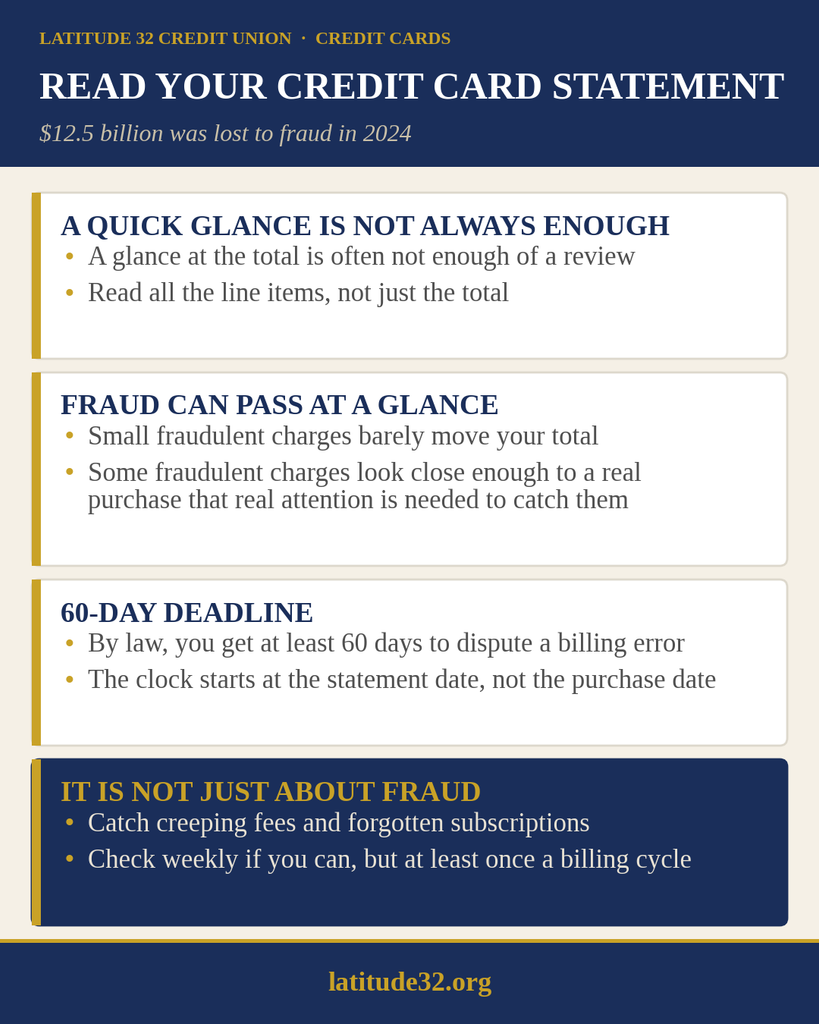
- Glancing at your total due is probably not enough.
- Some fraudulent charges look completely normal until you take a close look.
- The 60-day window to dispute a billing error starts from your statement date, not the purchase date.
- Checking weekly or biweekly catches and resolves problems faster than waiting for the full billing cycle.
- Reviewing your statement regularly also catches creeping fees, forgotten subscriptions, and spending patterns before they become a problem, not just fraud.
- Checking weekly or biweekly catches and resolves problems faster than waiting for the full billing cycle.
Many of us review a credit card statement by giving a glance at the total, signing off, and moving on. And for most months, for most of us, that’s fine. The total looks about right, so what is there to worry about?
That’s exactly the behavior that scammers use to max out cards with fraudulent charges. Consumers reported losing $12.5 billion to fraud in 2024, which was a 25% jump over the year before, according to the FTC. Some of that money left accounts through charges that probably would have been identified as fraudulent if they’d been given a careful look. The trouble is, a “careful look” and “quick glance” are not the same thing, and most of us stick with the second option.
The Charges People Catch
Some fraud is easy enough to catch. A charge in a foreign currency is an obvious one. A $1,000 purchase from a merchant you never buy from is another. These jump off the page because they don’t fit your regular pattern at all. They tend to stick out like a sore thumb against everything else on your statement (assuming you look at your statement).
Fraud Doesn’t Announce Itself
A fraudulent charge is only caught if somebody is actually looking for it. Glance at a total instead of the list of individual transactions, and even a fraudulent charge can sail right through. Not all fraud is for thousands of dollars; some could be in the form of a low-level, recurring subscription you never signed up for. That is not a charge you’re likely to catch just by looking at the total. And some fraudulent charges are made to look as ordinary as they can be made to look; the fraudsters try to make the charge close enough to something you might plausibly have bought that a rushed glance won’t catch the crime.
Why the Clock Matters
Under the Fair Credit Billing Act, you get 60 days to dispute a billing error, and the clock starts on the date the statement showing that error was sent to you. Let a statement sit unopened for a few weeks, and you’re burning through a chunk of the window the law gives you to make things right.
None of your rights under the Fair Credit Billing Act will help you if the charge goes unnoticed until your window is closed. The FTC’s advice here is to keep an eye on your account, and report anything unfamiliar as soon as you spot it.
The Other Reason to Review: Your Own Spending
Fraud isn’t the only thing a quick glance misses. Reviewing your expenses regularly is also just good financial housekeeping, and it enables you to:
Track your spending against your budget. It’s easy to feel like you know more or less what you spent this month. It’s another thing entirely to see it laid out, transaction by transaction, and to go through it line by line to find where (and why) the actual total landed versus what you expected.
Spot patterns before they become habits. A subscription you forgot to cancel. A food delivery app you’ve been using more than you can afford. Expenses such as these typically ruin budgets over time as costs creep up, unnoticed and uncorrected. It’s easy to miss a few dollars here and there if you look only at the total until they’ve added up to something unsustainable. It’s best to catch it before then.
Catch fees and interest before they pile up. Late fees, annual fees, and interest on any balance you’re carrying all show up on your statement. Reviewing your statement regularly means catching a fee that seems off, or a rate that’s crept up, instead of discovering it three months later buried under a much bigger bill. A look back at past statements helps you check your spending habits, plan your budget, and avoid exactly these kinds of fees in the future.
Never miss a due date. Your statement has your payment due date and minimum payment sitting right on it. A regular glance doubles as a built-in reminder, and missing a payment costs more than just a fee: it can hurt your credit score too. Autopay for at least the minimum takes the guesswork out of it, though it’s still worth reviewing before the payment goes through, not after.
What Reviewing Actually Looks Like
So what does a real review look like?
Read every line, not just the total. A bottom-line number can look completely normal even when one of the charges that added up to it wasn’t legitimate.
Check merchant names and locations, not just amounts. An unfamiliar name is worth taking another look at, even when the dollar figure is not high enough to set off your alarm bells by itself.
Compare against your memory and receipts. Most of us don’t save receipts, but it can help when trying to determine the legitimacy of a charge later.
Check your credit limit and utilization while you’re at it. Knowing how close you are to your limit helps you budget for the rest of the cycle, and utilization is one of the bigger factors behind your credit score.
Look at fees and interest specifically, not just the transaction list. Fees and interest are not items most of us want to budget for. If you incurred any, you should understand exactly why so you can minimize this type of expense in the future.
Make a schedule. “I’ll get to it eventually” is how a statement goes unread for a month at a stretch. Pick a day, whether weekly or once every two weeks, and stick to it.
Making It Easier: Alerts and Frequency
Most issuers let you set up transaction alerts, such as a text or notification every time a charge posts, or every time one crosses a dollar threshold you choose. Alerts make a solid backstop, but they’re a supplement to review, not a stand-in for it. An alert tells you a charge happened. You still may have to check that charge was actually yours, or if it was a fee you’d forgotten was coming.
Regarding frequency, the FTC recommends checking your statement as soon as possible. We recommend checking your account activity weekly or every couple of weeks, rather than waiting for the full monthly statement.
Where to Go From Here
If you’ve spotted something on your statement that doesn’t look right, How Do I Dispute a Charge on My Credit Card Bill? walks through what to do next. And if you’re weighing how much you’d actually be on the hook for depending on how you paid, our payment method liability calculator can run the numbers for your specific situation.
And if reviewing your statement has you taking a harder look at the card itself to see if the rate, the fees, and whether it’s actually working in your favor, then we want you to know that the Latitude 32 Visa carries a fixed 12.90% APR that hasn’t moved in over a decade (as of August 2026), with no annual fee, no balance transfer fee, and no penalty rate. Learn more or apply for the Latitude 32 Visa, or stop by any of our Charleston-area branches.