

Key Takeaways
- Caller ID can be faked fully and frequently: a scammer can make any name or number appear on your screen, including your credit union’s.
- Spoofing isn’t always illegal. It’s spoofing to defraud or cause harm that is a federal crime.
- Scammers often spoof your local area codes specifically to get you to pick up.
- The one habit that defeats spoofing every time is to hang up, then call back using a number you find yourself. Never use a callback number the caller gives you.
Interactive Spoofing Quiz: What Would You Do?
Your phone rings, and the screen says it’s your credit union. It doesn’t show up as an unknown number. Your phone clearly says that the person calling is from your actual credit union, name and number and everything, plain as day. So of course many of us answer, because why wouldn’t we?
As you suspect, there is a problem here. Seeing is believing, but when looking at a caller ID on your phone screen, it’s time to train ourselves not to believe what we see. Because the unfortunate truth is that what shows up on your caller ID is only as trustworthy as the person who typed it in. The FTC says that scammers can make any name or number show up on your caller ID.
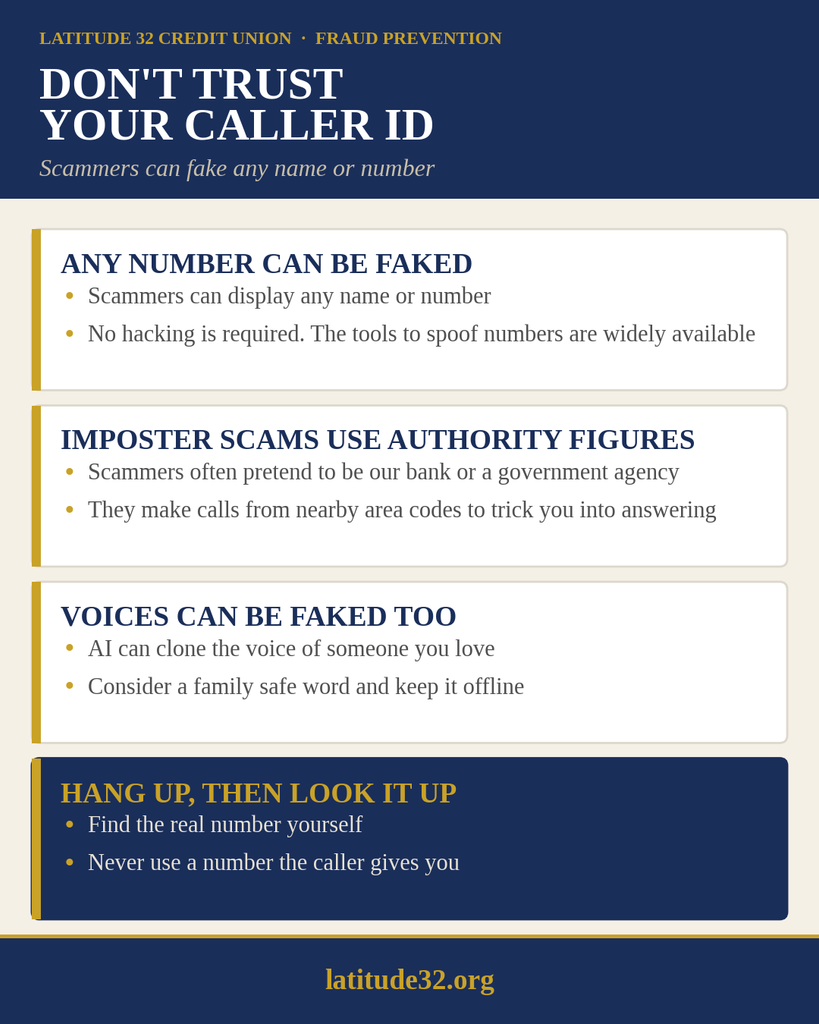
What Caller ID Spoofing Actually Is
Caller ID spoofing is exactly what it sounds like: faking the caller ID. Using basic, widely available technology, a scammer can set their outgoing call to display any name and any number they want. That means they can look like anyone from the IRS to your own next-door neighbor. It doesn’t matter. If they want it to show up on your screen, they can make it happen (as long as you don’t have any screening service active).
They don’t need to hack or break into anything. It’s not a sophisticated cybercrime. It’s more like filling out a form incorrectly and with malicious intent. That’s part of what makes it so unsettling: the barrier to entry is low, and the payoff for the scammer can be high.
Why Scammers Spoof the Specific Numbers They Do
Scammers don’t spoof numbers at random. There’s method to the madness.
Impersonating a trusted name — your bank, the Social Security Administration, the local sheriff’s office — borrows authority instantly. You’re primed to listen, and listen closely, the second you think you know who’s calling.
Then there’s a sneakier trick, sometimes called “neighbor spoofing.” Scammers match the caller ID to your own area code, and even the first few digits of your own phone number, so the call looks like it’s coming from right around the corner. AARP’s research bears this out: readily available spoofing tools let scammers make a call appear local or official specifically to boost the odds you’ll pick up. Familiar numbers get answered. Unfamiliar ones get ignored. Scammers know this, so they fake the familiar, plain and simple.
Is This Legal?
Spoofing itself isn’t always illegal. A business might legally display its main call-in number for outgoing calls rather than an employee’s direct line. That’s spoofing too, technically, just a harmless or even a constructive kind.
What crosses the line into federal crime is spoofing with intent to defraud, cause harm, or wrongly obtain something of value. That’s the Truth in Caller ID Act in a nutshell. It doesn’t outlaw the tool, it outlaws using the tool to cheat somebody. And cheating somebody is exactly what these fraudulent callers have in mind.
What’s Being Done About It
The phone industry hasn’t been sitting on its hands (not entirely). The FCC has pushed carriers to adopt call authentication technology that helps verify whether a call is actually coming from the number it claims to be coming from. When it works, it does help screen out scammers. Carriers can use this authentication technology to sometimes flag or block suspect calls before your phone ever rings.
But the caveat — and this is a fairly big caveat — is that this it isn’t foolproof. Not every carrier and not every call gets the full benefit, and scammers are nothing if not adaptable. Treat call-blocking and caller ID authentication as a helpful layer, not a guarantee. Trust, but verify, as they say. Except here, it’s more like: don’t trust, and verify anyway.
The One Habit That Defeats Spoofing
If there’s one single habit worth building from all of this, it’s this: hang up, then look it up.
If a call claims to be your bank, your credit union, a government agency, or anybody asking for money or personal information, don’t answer. If you do answer, hang up. Then find the real number yourself — the back of your card, a recent statement, the official website you type in on your own. Call that number and see what’s going on. Do not call any number the caller may give you.
This one habit alone defeats every version of this scam. Scammers are counting on you to trust the number in front of you. Don’t. Trust the number you went and found for the organization yourself.
Something else worth knowing: Fraudulent phone scams aren’t limited to spoofing numbers. Scam-prevention researchers now warn that AI can clone a familiar voice, too, meaning a “family emergency” call might sound exactly like someone you love, even when it isn’t them at all. The same hang-up-and-verify habit works here too. If they call asking for money and say they are calling from a friend’s phone because they lost their own, we still recommend you don’t call that number back. Call their real number instead and you’ll probably hear them answer. Some families go a step further and set up a private “safe word” nobody outside the family would know. This is a rock solid defense against family imposters; just don’t put the safe word online where it might be compromised.
What to Do During a Suspicious Call
A few more habits worth keeping in your back pocket:
Don’t press any buttons. Robocalls sometimes prompt you to “press 1 to speak to a representative” or “press 2 to be removed from our list.” Pressing anything just confirms your number is live and active, which, sadly, makes you more likely to get called again, not less. Scammers don’t care if you’re on any kind of no call list.
Don’t confirm anything. Real institutions don’t call you out of the blue and ask you to “confirm” your account number, Social Security number, or password. If someone’s asking you to confirm information they should already have, that’s your answer right there.
Don’t feel bad hanging up. You don’t owe a stranger on the phone your time, your patience, or your politeness. Hang up. It costs you nothing, and staying on the phone could cost you thousands if it is a scam.
Where to Go From Here
For more on when it’s actually safe to share your card number by phone, see Is It Ever OK to Give Your Card Number Over the Phone? For the text-message version of this same trick, see What Is Smishing? Tips to Defend Against Text-Based Scams. And for the full range of scams we’ve published on, visit our Fraud Prevention & Cybersecurity Resource Center.