

Your hub for everything Latitude 32 has published on choosing, using, and paying off a credit card — organized by what you’re actually trying to do.
Key Takeaways
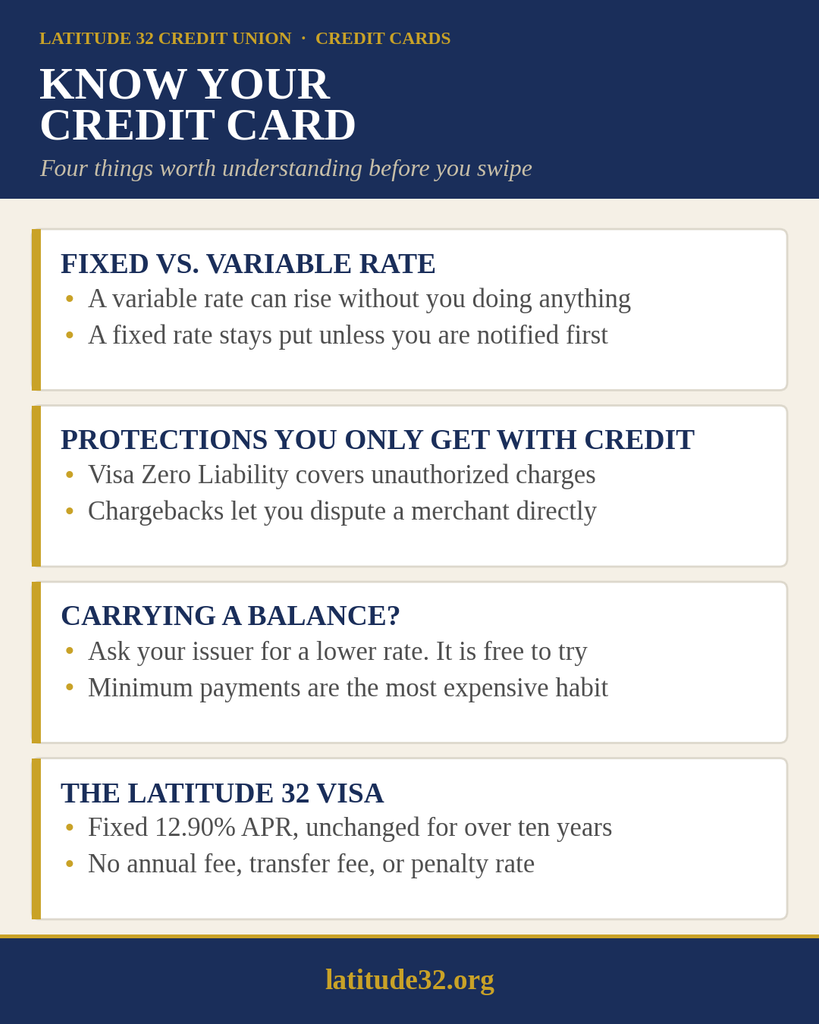
- Your card’s rate may be fixed or variable. Variable cards change when the market rate does.
- Credit cards have legal protections that debit cards, Zelle, Venmo, and wire transfers don’t have.
- If you’re carrying a balance, try: asking your card issuer for a lower rate, check if a balance transfer to another card will help, and understand that making the minimum payment is extremely expensive long term.
- The Latitude 32 Visa has held a fixed 12.90% APR for more than ten years as of August 2026, plus no annual fee, no balance transfer fee, and no penalty rate.
- When a balance transfer isn’t enough to give you a path out of your debt struggles, debt consolidation is worth considering.
A credit card is one of the most commonly used financial tools most Charleston and Lowcountry households own. But it’s important to understand a few things about your card so you get the most out of it. This guide pulls together everything we’ve published on the topic.
Choosing the Right Card
The single most overlooked detail when comparing credit cards isn’t the interest rate itself; it’s whether that rate is fixed or variable.
A variable rate is tied to a market index, typically the Prime Rate, which means your APR can rise without you missing a payment, changing your spending habits, or doing anything at all. A fixed rate stays where it was set unless the issuer gives you advance written notice of a change. For anyone who occasionally carries a balance, that distinction is worth understanding before you apply anywhere, whether you’re comparing a bank card or a credit union card.
Beyond rate type, a handful of other factors are worth weighing: whether the card charges an annual fee, whether it charges a fee to transfer a balance in, whether a missed payment triggers a penalty rate increase, and whether rewards are worth more to you than a lower rate. Credit union cards, including the Latitude 32 Visa, tend to differ from bank-issued cards on several of these points, which is worth a comparison between the two.
Related reading: Fixed-Rate vs. Variable-Rate Credit Cards: Why Your Rate Type Matters
Using Your Card Safely
Credit cards carry two layers of protection that debit cards and payment apps like Zelle or Venmo don’t offer, and how you pay determines whether you actually get to use them.
The first is Visa’s Zero Liability policy, which means you aren’t responsible for charges made without your authorization, provided you report them. The second is the chargeback — your right to formally dispute a charge with your card issuer when a merchant fails to deliver what was promised, even if that merchant refuses to cooperate. Together, these protections are the core reason a credit card is the safer default for online purchases specifically, and they’re the same protections behind the formal dispute process if you ever need to use one.
It’s also worth knowing what a legitimate request for your card number looks like versus a scam. The short version: if you initiated the call to an official phone number for a legitimate retailer yourself, there’s no need to worry. But if someone contacted you, make sure that you verify their standing independently before sharing anything. The best way to do this is to get the name of the company and what they are calling about, then hang up and call the official number for that company to check the claims of the caller.
Related reading:
- Why You Should Always Pay With a Credit Card Online
- How Your Latitude 32 Visa Card Protects Every Purchase
- How Do I Dispute a Charge on My Credit Card Bill?
- Is It Ever OK to Give Your Card Number Over the Phone?
For broader protection against scams that don’t involve your card directly, visit our Fraud Prevention & Cybersecurity Resource Center.
Managing Rates & Payments
If you’re carrying a balance, there are three ways that can help you pay less interest.
Ask for a lower rate. Most cardholders never do, and it works more often than people expect, especially if you have a consistent on-time payment history. This costs nothing to try and doesn’t affect your credit score.
Understand what a minimum payment actually does. A minimum payment that’s calculated as a percentage of your balance shrinks as your balance shrinks, which means less of each payment goes toward principal over time, not more. This is the single most expensive habit a cardholder can fall into without realizing it.
Check the math of a balance transfer. A promotional 0% offer can be useful, or it can cost more than staying put, depending on four numbers: your current rate, the transfer fee, and the rate that applies once the promotional period ends, and how much balance you’ll have at that point. Skipping any one of those numbers is how a balance transfer costs money instead of saving it.
We have a balance transfer break-even calculator that compares the options of staying put, a promotional transfer, and the Latitude 32 Visa side by side.
Related reading:
- How to Get a Lower Credit Card Interest Rate
- Is a Balance Transfer from One Card to Another Worth It?
Tackling Credit Card Debt
Sometimes the best option isn’t a better rate on the same card. If you’re managing debt across multiple cards, or a balance that a rate change alone won’t meaningfully address, options like a personal loan or another debt consolidation plan are worth understanding before you commit to a repayment strategy.
Related reading:
- Smart Ways to Take Control of Credit Card Debt
- Smart Strategies to Pay Off Your Credit Card Debt Quickly
Frequently Asked Questions
What credit card rate does Latitude 32 offer?
The Latitude 32 Visa carries a fixed 12.90% APR as of August 2026, a rate that has remained unchanged for more than ten years, with no annual fee and no balance transfer fee.
Is a credit card safer than a debit card for online purchases?
Yes. Credit cards carry Visa’s Zero Liability protection and full chargeback rights. Debit card fraud protections are narrower, and funds are withdrawn from your account immediately rather than held as a disputed liability.
How do I know if my card has a fixed or variable rate?
Check your card’s terms and conditions or your monthly statement. Look for the words “variable,” “Prime Rate,” or “index”; if you see them, that means that your rate can move with the market.
Will asking my card issuer for a lower rate hurt my credit score?
No. A phone call requesting a rate reduction does not generate a credit inquiry. Only new credit applications do that.
When does a balance transfer make sense?
When your current rate is sufficiently higher than the overall cost of the transfer, you have a realistic plan to pay off the balance before any promotional period ends, and the interest you’ll avoid exceeds any transfer fee. Our balance transfer calculator can run these numbers for your specific situation.
How do I dispute a charge on my credit card bill?
You have the right to dispute billing errors — unauthorized charges, wrong amounts, or goods that never arrived — directly with your card issuer, generally within 60 days of the statement showing the error. See our full guide to disputing a charge for the step-by-step process.
Why does paying only the minimum keep me in debt longer?
A minimum payment calculated as a percentage of your balance gets smaller as your balance gets smaller, which means less and less goes toward principal over time. A fixed payment above the minimum keeps you out of this trap.
Where to Go From Here
If you’re comparing your current card against a fixed, member-owned alternative, learn more or apply to the Latitude 32 Visa. You are also always welcome to stop by any of our Charleston-area branches! For everything else we publish on protecting your finances, visit the Fraud Prevention & Cybersecurity Resource Center.