

Key Takeaways
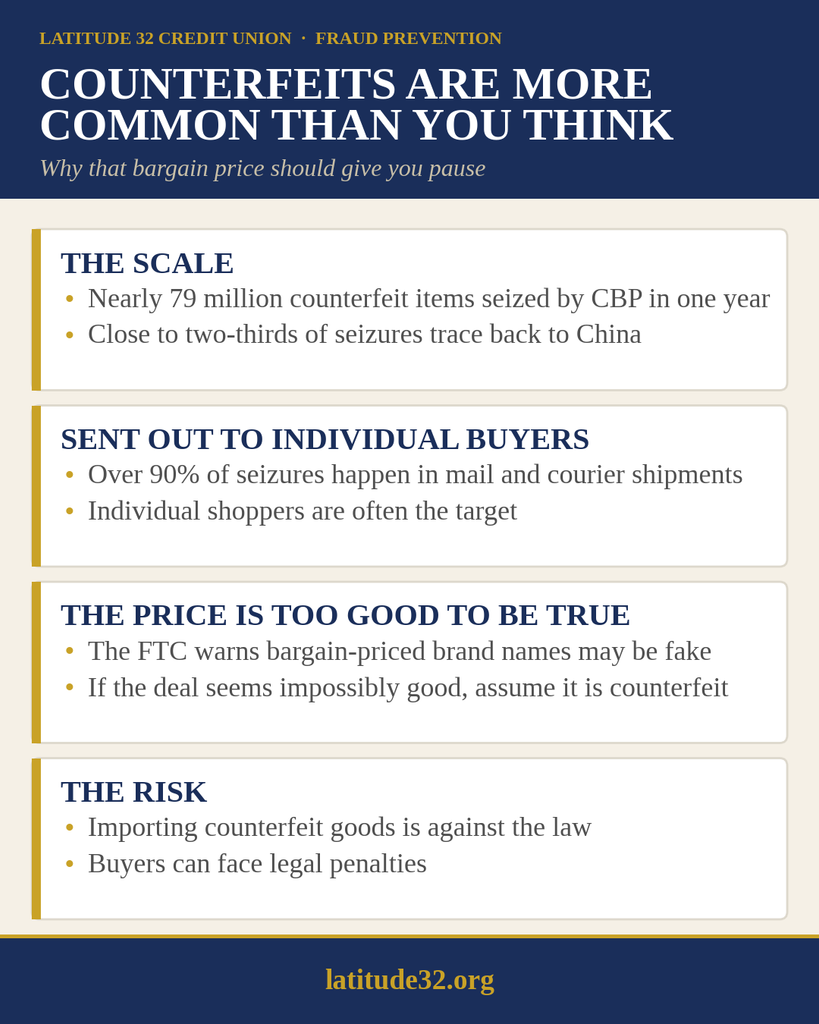
- Counterfeit goods aren’t rare: U.S. Customs and Border Protection seized close to 79 million counterfeit items in fiscal year 2025 alone.
- The majority of those seizures trace back to China and Hong Kong.
- Most counterfeit goods reach U.S. buyers through individual packages sent by mail or express courier.
- If the price is too good to be true, it probably is.
- Many odther detection signals are item-specific. What tips you off to a fake charger can be different from what tips you off to a fake supplement, or a fake handbag.
- Do more than read the reviews.
- Buying counterfeit goods can incur legal penalties for the buyer as well.
Even a legitimate-looking store, with a real-looking return policy and reasonable prices, can still sell you a fake. Here’s what to check about the product itself.
Where Counterfeits Actually Come From
The scale is bigger than most people assume. In fiscal year 2025, CBP reported seizing nearly 79 million counterfeit items, and the agency’s own consumer campaign page notes that close to two-thirds of all CBP intellectual property seizures in fiscal year 2023 originated from China.
More importantly for online shoppers specifically: the same CBP data shows that the overwhelming majority of counterfeit seizures (over 90%) happen in the international mail and express courier channels, not in large containerized shipments. That means that individual consumers are at risk of buying counterfeit products, not just vendors.
Category-by-Category: What to Actually Check
Generic advice like “buy from a store you trust” only goes so far. Here’s what to look for by product type.
Electronics
Counterfeit electronics are one of the categories CBP flags most consistently for genuine safety risk, not just quality disappointment, and they’re also some of the hardest fakes to catch. The Department of Energy’s own consumer electrical safety guidance notes that in a 2019 test, nine out of ten adults could not tell a counterfeit electrical product from a genuine one when they were shown side by side.
Part of why counterfeits are so hard to catch is that a common assumption doesn’t hold up: a certification mark like UL, ETL, or TUV printed on the product isn’t proof of anything on its own. Counterfeiters routinely fake these marks illegally. The safety mechanisms those certifications are supposed to guarantee like protection against overheating, fire, and explosion, are exactly what a counterfeiter is most likely to skip. The counterfeiter wants to make the most money without immediate detection, and those protections add cost without being visible to a buyer before something goes wrong.
Rather than looking for a certification mark and stopping there, check these four things:
- Quality — plastic shavings left in the packaging, exposed wiring, burrs, or any sign of rough workmanship
- Label — misspellings, grammatical errors, a certification logo that looks crooked or slightly off, or missing or incorrect manufacturer information
- Packaging — anything not in the manufacturer’s standard packaging, an incorrect or missing logo, or packaging that wouldn’t have protected the item during shipping
- Documentation — inconsistent fonts, altered-looking certificates, or dates and details that don’t match across the listing and the product itself
Counterfeit electronics detection often comes from noticing several small inconsistencies together, not one obvious giveaway.
Here’s one more sign if you’ve received the item and are unsure of its authenticity: Try going to the manufacturer’s own site and see whether it lets you register a warranty using the product’s serial number. A counterfeiter can’t offer that, because the number won’t exist in the manufacturer’s system. But at that point, you’ve already purchased the item. Reach out to your credit card company for details on your next step. They may want you to try to return the item, or you may be able to proceed straight to a dispute of the charge.
Clothing & Accessories
Stitching quality is a quick tell, such as uneven seams, loose threads, or fabric that doesn’t match the brand’s usual weight and texture. Additionally, many designer brands use specific authentication features: serial numbers, hologram tags, or QR codes that link to a verification page. Stick with items you can verify one way, or another.
Supplements
This is the category with the least regulatory oversight, and it shows. The FDA doesn’t pre-approve dietary supplements before they reach the market, which means a label isn’t a guarantee of what’s inside the bottle. Before buying an unfamiliar supplement brand, check how long they have been actively selling, and look for them in the FDA’s Health Fraud Product Database, a searchable list of products that have been cited for undeclared ingredients, false health claims, or other violations. Look for third-party testing seals like USP or NSF on the label, and then verify that claim. Click here to verify USP certification, or here to verify NSF certification. Treat any supplement with marketing claiming it has dramatic curative properties as an immediate red flag.
Luxury Goods
The safest path here is also the simplest: buy only through the brand’s own published list of authorized retailers. If you’re buying secondhand or through a resale platform, look specifically for one that offers third-party authentication as part of the transaction, and when in doubt, most luxury brands will verify a serial number directly if you contact them.
Seller History
Reading reviews is standard advice at this point, but it’s not specific enough for counterfeit detection. A listing can have hundreds of positive reviews and still be selling fakes, especially on large marketplaces where third-party sellers’ inventory can get mixed in with a brand’s legitimate stock under the same listing (this can happen on Amazon, for example). Search the seller’s name or the product alongside the word “fake” or “counterfeit” specifically; this surfaces complaints that wouldn’t otherwise show up, though it is not a foolproof method. Also watch for reviews that mention the item arriving different from the listing photos, wrong packaging, or missing accessories that should have been included.
The FTC says: “If expensive brand-name items are offered for bargain prices, they could be counterfeit or stolen.” Be very cautious.
The Legal Risk
Most people assume buying a fake only risks their own money, and at worst they may end up with a disappointing product, or maybe a difficult return. But importing counterfeit or pirated merchandise is against the law, and individual consumers may be held liable for penalties or fines. This isn’t a common outcome for a single small purchase, but it’s important to note that it’s a real legal exposure. And it’s one that most shoppers don’t know exists. You can use this reasonable concern about the law to counter that fear of missing out which counterfeiters use to such effect.
Where to Go From Here
For the broader framework on vetting an entire store before you buy anything at all, see How to Tell If an Online Store Is Legitimate. For the specific red flags that show up in a bad deal regardless of product authenticity, see 6 Red Flags That an Online Deal Is Too Good to Be True.
And for the full range of scams we track year-round, visit our Fraud Prevention & Cybersecurity Resource Center.