

In a recent survey, roughly three out of four online shoppers said they already recognize a suspiciously low price as a warning sign, but while that seems like good news, more than half of those same people had recently lost money to a scam anyway. Knowing the red flag and recognizing it and acting on it in the moment aren’t the same thing. Scams can strike at any time that scammers can make contact with you. They can make contact in any number of ways from phone calls to legitimate-looking advertisements. It’s hard to be suspicious when you’re scrolling on your phone, and an apparently amazing deal appears right in front of you.
Let’s take a deeper look at six specific signals that the price, the payment method, or the page you’re looking at isn’t what it claims to be.
1. The Price Is Dramatically Below Retail
You Should Be Especially Suspicious of Countdowns
A steep discount alone doesn’t determine something is a scam. But when an unknown retailer’s price for a branded product is dramatically lower than what every other retailer charges for the same item, you should be suspicious. You should be even more suspicious when it’s paired with pressure to act fast (such as a countdown timer, “only 2 left in stock,” or a banner that says the deal expires tonight), then the odds are high it’s a scam. Scammers rely on urgency specifically because the fear of missing out on a great deal can often overcome the fear of being scammed. If someone is trying to sell you on buying a “great deal” and pressuring you to act fast, that’s a serious warning sign. Remember that legitimate retailers need to make a profit. Scammers don’t, and can price their imaginary products as low as they like. Scammers frequently use a “going out of business” trick to justify their unbelievably low prices.
As complicated and convoluted as scams can become, the fix for this, at least, is simple: open a new tab and search the product name at two or three retailers you already trust. If the “deal” price is 60% or more below what everyone else charges, treat that “opportunity” as a scam.
2. Missing or Unverifiable Contact Information
Scroll to the footer at the bottom of the website’s pages. A legitimate store you can trust will have a real street address (not just a city), a phone number that reaches an actual person, and a customer service email tied to the store’s own domain rather than a generic Gmail, Outloo, or Yahoo address. If you can’t find any of that and the “Contact Us” page has only a form with no email or phone, then you can be quite certain that no one will help you if something goes wrong.
This is worth checking before you buy. A store hiding its contact information is likely hiding other crucial details, as well, and should be treated with suspicion.
3. The Checkout Only Accepts Zelle, Wire Transfer, or Gift Cards
This is the single most reliable scam signal on this list. Zelle, wire transfers, and gift cards all share one property that makes them irresistible to scammers: once the money moves, it’s irretrievable to the sender. Scammers reveal their intent to keep your money against your wishes by choosing payment methods that do not allow you to get your money back for any reason.
On the other hand, a legitimate retailer accepts standard payment methods with built-in protections. A seller who insists on Zelle, a wire transfer, or gift card codes as the only accepted payment is telling you, directly, that they’re trying to get your money and make sure that there’s no way you can get it back.
If gift cards specifically are being requested, our deeper look at gift card scams covers the mechanics of exactly how that con works. But the short answer is: don’t pay by gift card for anything, at any time. In contrast to gift cards, paying by credit card gives you a dispute process if something goes wrong. This is a good reason to reach for a credit card over a debit card when buying from online vendors you haven’t purchased from before.
But again, if the seller shows any of these red flags, it’s probably best to avoid them entirely.
4. The Product Photos Look Generic, AI-generated, or Like Stock Photography
Look closely at the product images. Are they oddly polished compared to the rest of the site? Do they look like they could be lifted from any other store selling a similar item? Scam storefronts frequently pull product photography straight from some real company’s marketing materials or from stock photo libraries. Since many scams are short-term cash grabs, that means building original photography for products they don’t plan to send you anyway isn’t worth the effort.
A quick way to check: right-click a product photo and run a reverse image search. If the exact same image turns up on ten other unrelated sites at ten different prices, that’s a strong signal the “store” in front of you is one you should not be buying from.
5. The Domain Name Is a Knockoff of a Real Brand
Scammers frequently register domains that are one letter, one hyphen, or one extra word off from a brand you already trust. Many people don’t look closely at URLs, and the scammers are hoping that you won’t notice before you become a victim. If you’re used to shopping at a site like www.amazon[.]com, and you land instead on something like www.aamazon[.]deals, scammers are hoping their fraudulent domain will be close enough to pass a quick glance, even enough it belongs to another company entirely.
It’s a good practice to frequently look at the URL in your address bar and inspect it character by character. If it’s a version of a brand name with anything added, removed, or swapped, close the tab and navigate to the real site directly instead.
6. Fine Print Hiding Fees, Subscriptions, or Return Restrictions
Some of the least obvious scams will send you a product, but not what you expected. These scams are, in a sense, real transactions, but with terms hidden and designed to hold onto your money no matter what. Or perhaps an unbelievably low price increases dramatically once “processing fees” or other shipping charges and fees are added. An increasingly popular scam is when a one-time purchase turns into a monthly subscription that’s deliberately difficult to cancel. A generous-sounding return policy turns out to require you to pay return shipping to an overseas address. Allstate Identity Protection’s research on this pattern notes that this kind of misleading fine print can be buried behind a hyperlink or tucked into a checkout screen specifically because most shoppers don’t read that far.
Though almost all of us are used to scrolling past terms instead of reading them, it’s important to remember that some terms are designed to take advantage of you. When buying from a retailer for the first time, be sure you understand what happens after you click the buy button.
Your Six-Part Quick Check
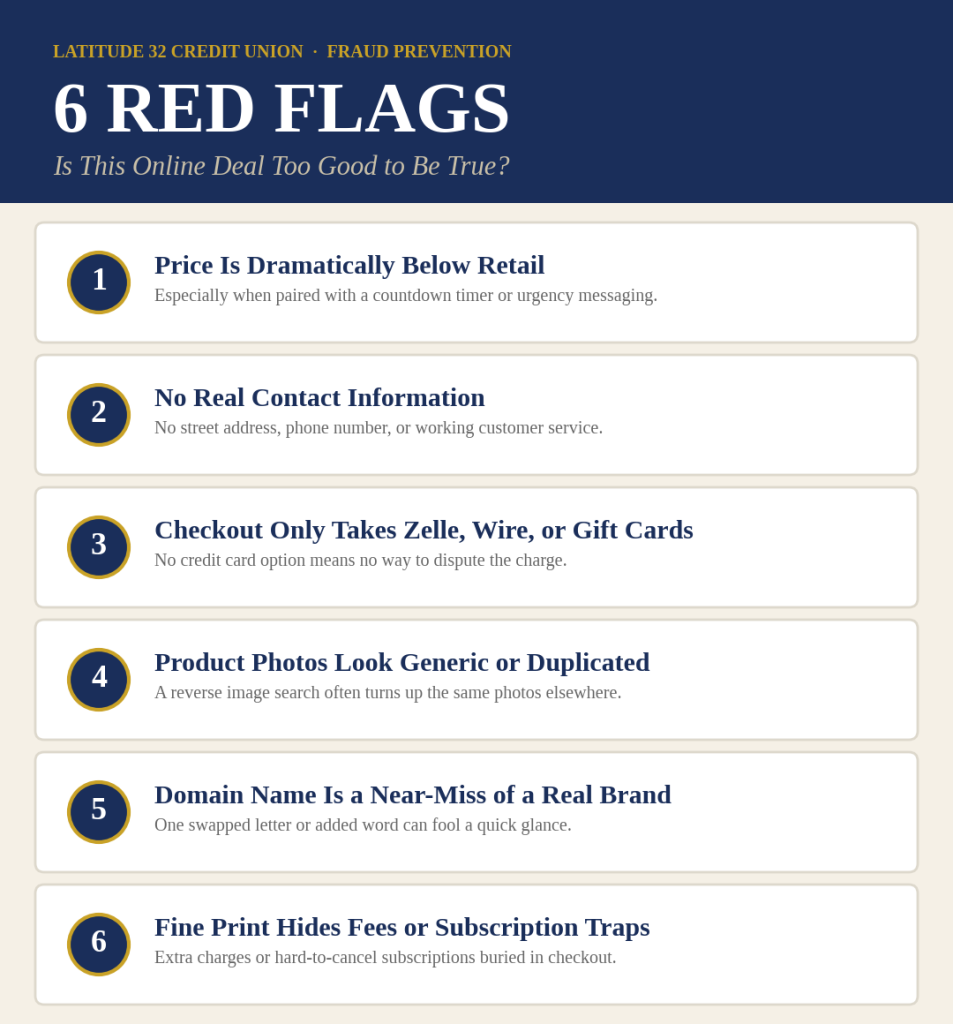
- Price — Dramatically below retail, especially paired with countdown pressure
- Contact info — No real address, phone number, or working customer service
- Payment method — Zelle, wire transfer, or gift cards as the only option
- Product photos — Generic, stock-looking, or duplicate imagery from other sites
- Domain name — A near-miss knockoff of a brand you already know
- Fine print — Hidden fees, surprise subscriptions, or restrictive return terms
Where to Go From Here
Any one of these flags is enough of a potential problem to take a very careful look at the unknown retailer you are interested in. Two (or more) together is worth navigating away from the website permanently without purchasing. Stay suspicious and stay safe.
For the full range of scams we track year-round, visit our Fraud Prevention & Cybersecurity Resource Center.