

How to Tell a Real USPS, FedEx, or UPS Message from a Fake
Your phone buzzes. A text message says there’s a problem with your delivery, such as: “click this link to reschedule,” “confirm your address,” or “pay a small redelivery fee.” The message looks plausible. You might be expecting a package, and the apparent urgency worries you that something is about to go wrong if you don’t act quickly.
This is one of the most common scams in America.
According to the Federal Trade Commission, fake package delivery texts were the single most commonly reported type of text scam in 2024, with consumers losing $470 million to text scams overall. That is over five times the losses reported in 2020. The package delivery variant works because it exploits a reasonable expectation: many Americans are waiting on some online order to be delivered at any given moment, and a text about a delivery problem feels natural and urgent.
Understanding exactly what the major carriers send and don’t send by text, and what the anatomy of a fraudulent message looks like, is the most reliable protection against this extremely prevalent scam.
What USPS Actually Sends
And What It Never Sends
The U.S. Postal Inspection Service is unambiguous on this point: USPS will not send customers a text message or email unless the customer first requested it with a specific tracking number. Even then, the message will not contain a link.
Read that again: if you receive a text claiming to be from USPS that contains a link, it is a scam. USPS does not include links in its tracking notifications.
What USPS does send, when you’ve requested it:
- Status updates for a specific tracking number you registered
- Notifications via the Informed Delivery service if you’ve enrolled
What USPS never sends:
- Unsolicited texts about packages you haven’t registered for tracking
- Text messages with links
- Messages asking you to pay a fee, redelivery charge, or customs cost
- Texts requesting personal or financial information
If you’re expecting a package and receive an unsolicited text about a delivery issue, do not click anything. Instead, go directly to USPS.com by typing the address yourself, and enter your tracking number there.
What FedEx Actually Sends
And What It Never Sends
FedEx’s official fraud guidance is similarly clear: “FedEx does not request, via unsolicited mail, email, or text, any personal information pertaining to your account credentials or identity.” Any text you receive from FedEx that you did not request, or that asks for payment or information, should be ignored and the number blocked.
FedEx texts through two opt-in services: FedEx Delivery Manager (which requires you to enroll) and its SMS tracking service (which requires you to sign up). If you haven’t done either of those things, any text claiming to be from FedEx isn’t.
What FedEx does send, when you’ve enrolled:
- Delivery status updates through Delivery Manager
- Tracking alerts for a shipment you registered via SMS
What FedEx never sends:
- Unsolicited texts about packages
- Messages requesting payment for delivery or customs
- Links asking you to “set delivery preferences” or confirm your address
- Messages asking for your Social Security number, credit card, or for you to login
Forward suspicious emails to [email protected].
What UPS Actually Sends
And What It Never Sends
UPS follows the same consent-first model. According to UPS’s official SMS terms, you must opt in before UPS will text you, either through a UPS My Choice account or by requesting tracking updates for a specific shipment. All legitimate UPS texts come from the short code 75137 or 24031 in the United States, not from a regular 10-digit phone number.
If a message claiming to be UPS comes from a regular phone number or contains a link that doesn’t go to UPS.com, it’s a scam.
What UPS does send, when you’ve opted in:
- Package status and delivery updates for tracked shipments
- Delivery exception notifications (missed attempts, schedule changes)
What UPS never sends:
- Unsolicited texts that you haven’t opted in to receive
- Texts from 10-digit phone numbers (legitimate UPS texts come from 75137 or 24031)
- Links to non-UPS.com websites
The Anatomy of a Fake Delivery Text
Fake delivery texts follow recognizable patterns. Knowing what to look for makes them much easier to spot.
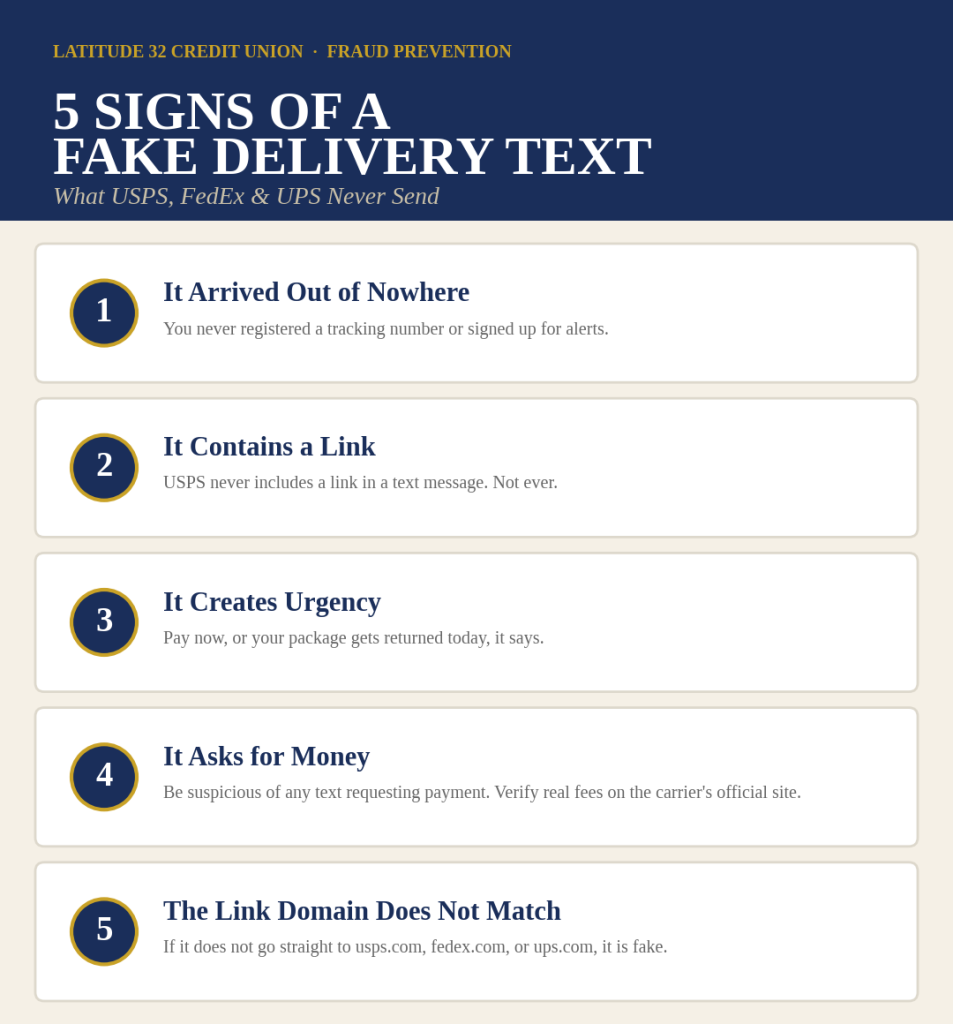
The message arrived without any action on your part. You didn’t register a tracking number, sign up for text alerts, or initiate any contact with the carrier. A text that arrives out of nowhere about a delivery is the first serious red flag. Pay no attention to how plausible it sounds.
It contains a link. As noted above, USPS never includes links in text notifications. FedEx and UPS links, when they appear in legitimate texts, go exclusively to their official domains — fedex.com and ups.com. A link that goes anywhere else is a scam. Look at the URL carefully before clicking anything: scammers use domains like usps-delivery[.]com, fedex-track[.]net, or variations that look almost right but lead you deeper into a trap.
It creates urgency. “Your package will be returned to sender today.” “Delivery failed — respond within 24 hours.” “A small redelivery fee is required before we can release your package.” Time pressure is a deliberate manipulation tactic designed to make you act before you think. Legitimate carriers hold packages; they don’t threaten to return them unless you pay immediately.
It asks for money. Any text requesting payment to release or redeliver a package is extremely suspicious. It is possible that UPS may alert you to payment needed due to customs, for example, but don’t pay it through a text. Instead, navigate to the delivery provider’s website and track the package from there to determine any necessary charges.
It requests personal or account information. No legitimate carrier will ask for your Social Security number, date of birth, PIN, or account credentials via text message. That is a scam.
It comes from a 10-digit number or an unfamiliar short code. Legitimate carrier texts come from registered short codes, not regular phone numbers. That said, phone numbers can be spoofed, and a message appearing to come from a legitimate short code can still be fraudulent. The content of the message matters more than the number it came from.
The link domain doesn’t match the carrier. Even if the message says “USPS” or “FedEx,” the link tells the truth. Hover over or long-press the link before tapping to see the full URL. If it doesn’t go directly to usps.com, fedex.com, or ups.com, don’t click it. It’s a scam.
What Scammers Do with Your Click
When you tap a link in a fake delivery text, one of several things typically happens:
Credential harvesting. A link that isn’t quite right takes you to a page that looks exactly like USPS, FedEx, UPS, or Amazon, down to the logo and color scheme. You’re prompted to log in. The fake login page captures your username and password and sends them to the scammer. Those credentials are then used to access your account on the real delivery provider’s website, or sold to a third party to be exploited later.
Payment card theft. You’re asked to pay a small “redelivery fee”, often low enough to be tempting. Entering your card details gives the scammer your full card number, expiration date, and CVV. The small charge is typically just an trick to steal your card information to use later.
Malware installation. Some links install malware on your device that can log keystrokes, access saved passwords, and capture credit card information used in subsequent transactions. This can happen even if you don’t enter any information on the page that loads.
Subscription trap. The link takes you through a survey or form and ends with a pre-checked subscription to a service that charges you monthly. This was the mechanism behind a widely reported FedEx text scam in which fake “delivery preference” pages led users to a subscription charging nearly $100 per month.
What to Do If You Receive a Suspicious Delivery Text
Do not click the link. This is the only thing that matters in the first moment. Don’t tap it to “see where it goes.” Don’t open it to check if it’s real. Leave it alone.
If you’re expecting a package, go directly to the carrier’s official website by typing the address yourself — usps.com, fedex.com, or ups.com — and enter your tracking number there. If there’s actually a problem with your delivery, it will show up in the official tracking system.
Delete the message. Don’t reply, even to say “STOP”. Replying to a scammer won’t make them stop. It only serves as confirmation to them that your number is active and can result in more scam texts. Just block it.
Report it. The U.S. Postal Inspection Service provides specific guidance for USPS-related smishing. Here’s a quote from their webpage:
“To report USPS related smishing, send an email to [email protected].
- Without clicking on the web link, copy the body of the suspicious text message and paste into a new email.
- Provide your name in the email, and also attach a screenshot of the text message showing the phone number of the sender and the date sent.
- Include any relevant details in your email, for example: if you clicked the link, if you lost money, if you provided any personal information, or if you experienced any impacts to your credit or person.
- The Postal Inspection Service will contact you if more information is needed.
- Forward the smishing/text message to 7726 (this will assist with reporting the scam phone number).”
For all carriers, forward the suspicious text to 7726 (SPAM). This is the universal shortcode used by U.S. wireless carriers to report spam texts and helps carriers identify and block scam numbers. You can also report at ReportFraud.ftc.gov.
If you already clicked the link, contact Latitude 32 Credit Union immediately if you entered any account or payment information. The faster your financial institution is notified, the more options remain available. Also consider placing a fraud alert or credit freeze with the three major credit bureaus (Equifax, Experian, and TransUnion) if you provided personal information such as your date of birth or Social Security number.
Why This Scam Works So Well
Text scam losses jumped 26% from 2023 to 2024, even as the number of reported scam incidents declined. That implies that each individual scam is becoming more costly. Package delivery scams, specifically, are effective for a combination of reasons the FCC and fraud researchers have documented:
People are nearly always expecting something. Statistically, at any given moment, a large share of Americans have an outstanding online order. Scammers don’t need to know you specifically ordered something. They don’t need you in particular to respond at all, for they cast a large net. In their minds, they just need to send enough texts to recipients who might be waiting on a package and victimize whoever responds.
Texts feel more personal and urgent than email. A message on your phone feels immediate in a way an inbox message doesn’t, and people tend to be less guarded about links in texts than in email.
The links are harder to inspect. On a desktop, hovering over a link reveals the URL. On a phone, the destination may be hidden until you tap the link. That makes it harder to apply the link-checking habit that protects people in email contexts.
The “redelivery fee” is deliberately small. A $2.99 redelivery fee doesn’t trigger the same alarm response as a request for a large sum. It’s designed to slip by you without triggering any mental alarms, while still capturing your full payment card details.
The Habit That Protects You
Every piece of advice in this post reduces to one behavior: when a text about a delivery problem arrives, go to the carrier’s website directly rather than using any link in the message. Type usps.com, fedex.com, or ups.com yourself. If you are waiting on a package, then your tracking information is there. Any real delivery issue will show up in the official system.
If a problem is real, you can address it through official channels. If the text was a scam (and it probably was), then you’ve only protected yourself by ignoring the link.
For more on how to recognize and respond to text-based scams more broadly, see What Is Smishing? Tips to Defend Against Text-Based Scams and How to Spot and Avoid Text Scams. For a wider look at the scam landscape, visit the Latitude 32 Fraud Prevention & Cybersecurity Resource Center.
Frequently Asked Questions
Does USPS ever send text messages with links?
No. The U.S. Postal Inspection Service is clear on this point: USPS does not send text messages or emails unless a customer first requested the service with a specific tracking number, and even those messages do not contain links. Any USPS text with a link is a scam.
Does USPS charge redelivery fees via text?
No. USPS does not charge for tracking services and does not request payment via text message. Any text requesting a fee to release or redeliver a package is fraudulent, regardless of how official it appears.
How do I know if a text from FedEx is real?
FedEx does not send unsolicited texts. You should only receive FedEx texts if you enrolled in FedEx Delivery Manager or initiated SMS tracking for a specific shipment. Any FedEx text you didn’t request should be reported to [email protected] and deleted.
I already clicked the link. What do I do?
Contact Latitude 32 Credit Union immediately if you entered any payment or account information. If you provided your Social Security number or date of birth, place a fraud alert and/or credit freeze with Equifax, Experian, and TransUnion. Change any passwords that may have been compromised. Report to the FTC at ReportFraud.ftc.gov and to the USPS Inspection Service at [email protected] if the text impersonated USPS.
How do I report a fake delivery text?
Forward the text to 7726 (SPAM). This works for all carriers and helps your wireless carrier identify and block the scam number. For USPS-specific smishing, email [email protected] with the text body, a screenshot, and any relevant details. Report to the FTC at ReportFraud.ftc.gov. You can also file a complaint with the FBI’s Internet Crime Complaint Center at ic3.gov.